

Bovine Ig(Total Immunoglobulin) ELISA Kit使用說明書
Bovine Ig(Total Immunoglobulin) ELISA Kit
Catalogue No: EB0001 Size: 48T/96T Reactivity: Bovine
Detection Range: 1.563-100ug/ml
Sensitivity: <0.938ug/ml
Application: For quantitative detection of Ig in serum, plasma, tissue homogenates and other biological fluids.
Storage: 4°C for 6 months
NOTE: FOR RESEARCH USE ONLY.
Kit Components
| Item | Specifications(48T/96T) | Storage |
| ELISA Microplate(Dismountable) | 8×6 /8×12 | 4°C/-20°C |
| Lyophilized Standard | 1 vial/2 vial | 4°C/-20°C |
| Sample / Standard Dilution Buffer | 10ml/20ml | 4°C |
| Biotin-labeled Antibody (Concentrated) | 60ul/120ul | 4°C |
| Antibody Dilution Buffer | 5ml/10ml | 4°C |
| HRP-Streptavidin Conjugate(SABC) | 60ul/120ul | 4°C(shading light) |
| SABC Dilution Buffer | 5ml/10ml | 4°C |
| TMB Substrate | 5ml/10ml | 4°C(shading light) |
| Stop Solution | 5ml/10ml | 4°C |
| Wash Buffer (25X) | 15ml/30ml | 4°C |
| Plate Sealer | 3/5pieces | |
| Product Description | 1 copy |
Principle of the Assay
This kit was based on sandwich enzyme-linked immune-sorbent assay technology. Anti- Ig antibody was pre-coated onto 96-well plates. And the biotin conjugated anti- Ig antibody was used as detection antibodies. The standards, test samples and biotin conjugated detection antibody were added to the wells subsequently, and washed with wash buffer. HRP- Streptavidin was added and unbound conjugates were washed away with wash buffer. TMB substrates were used to visualize HRP enzymatic reaction. TMB was catalyzed by HRP to produce a blue color product that changed into yellow after adding acidic stop solution. The density of yellow is proportional to the Ig amount of sample captured in plate. Read the O.D.
absorbance at 450nm in a microplate reader, and then the concentration of Ig can be calculated.
Precautions
This kit was based on sandwich enzyme-linked immune-sorbent assay technology. Anti- Ig antibody was pre-coated onto 96-well plates. And the biotin conjugated anti- Ig antibody was used as detection antibodies. The standards, test samples and biotin conjugated detection antibody were added to the wells subsequently, and washed with wash buffer. HRP- Streptavidin was added and unbound conjugates were washed away with wash buffer. TMB substrates were used to visualize HRP enzymatic reaction. TMB was catalyzed by HRP to produce a blue color product that changed into yellow after adding acidic stop solution. The density of yellow is proportional to the Ig amount of sample captured in plate. Read the O.D.
absorbance at 450nm in a microplate reader, and then the concentration of Ig can be calculated.
Precautions
- To inspect the validity of experiment operation and the appropriateness of sample dilution proportion, pilot experiment using standards and a small number of samples is recommended.
- After opening and before using, keep plate dry.
- Before using the Kit, spin tubes and bring down all components to the bottom of tubes.
- Storage TMB reagents avoid light.
- Washing process is very important, not fully wash easily cause a false positive.
- Duplicate well assay is recommended for both standard and sample testing.
- Don’t let Micro plate dry at the assay, for dry plate will inactivate active components on plate.
- Don’t reuse tips and tubes to avoid cross contamination.
- Avoid using the reagents from different batches together.
- Microplate reader (wavelength: 450nm)
- 37°C incubator
- Automated plate washer
- Precision single and multi-channel pipette and disposable tips
- Clean tubes and Eppendorf tubes
- Deionized or distilled water
Manual Washing
Discard the solution in the plate without touching the side walls. Clap the plate on absorbent filter papers or other absorbent material. Fill each well completely with 350ul wash buffer and soak for 1 to 2 minutes, then aspirate contents from the plate, and clap the plate on absorbent filter papers or other absorbent material. Repeat this procedure two more times for a total of THREE washes.
Automatic Washing
Aspirate all wells, and then wash plate THREE times with 350ul wash buffer. After the final wash, invert plate, and clap the plate on absorbent filter papers or other absorbent material. It is recommended that the washer shall be set for soaking 1 minute.
Sample Collection and Storage
Isolate test samples soon after collecting, then, analyze immediately (within 2 hours). Or aliquot and store at -20°C for long term. Avoid multiple freeze-thaw cycles.
Discard the solution in the plate without touching the side walls. Clap the plate on absorbent filter papers or other absorbent material. Fill each well completely with 350ul wash buffer and soak for 1 to 2 minutes, then aspirate contents from the plate, and clap the plate on absorbent filter papers or other absorbent material. Repeat this procedure two more times for a total of THREE washes.
Automatic Washing
Aspirate all wells, and then wash plate THREE times with 350ul wash buffer. After the final wash, invert plate, and clap the plate on absorbent filter papers or other absorbent material. It is recommended that the washer shall be set for soaking 1 minute.
Sample Collection and Storage
Isolate test samples soon after collecting, then, analyze immediately (within 2 hours). Or aliquot and store at -20°C for long term. Avoid multiple freeze-thaw cycles.
- Serum: Place whole blood sample at room temperature for 2 hours or put it at 4°C overnight and centrifugation for 20 minutes at approximately 1000×g, Collect the supernatant and carry out the assay immediately. Blood collection tubes should be disposable, non-pyrogenic, and non-endotoxin.
- Plasma: Collect plasma using EDTA-Na2 as an anticoagulant. Centrifuge samples for 15 minutes at 1000×g at 2 - 8°C within 30 minutes of collection. Collect the supernatant and carry out the assay immediately. Avoid hemolysis, high cholesterol samples.
- Tissue Homogenates: As hemolysis blood has relation to assay result, it is necessary to remove residual blood by washing tissue with pre-cooling PBS buffer (0.01M, pH=7.4). Mince tissue after weighing it and get it homogenized in PBS (the volume depends on the weight of the tissue. Generally speaking, 9mL PBS would be appropriate to 1 gram tissue pieces. Some protease inhibitors are recommended to add into the PBS) with a glass homogenizer on ice. To further break the cells, you can sonicate the suspension with an ultrasonic cell disrupter or subject it to freeze-thaw cycles. The homogenates are then centrifuged for 5minutes at 5000×g to get the supernate.
- Cell Culture supernate: Centrifuge supernatant for 20 minutes at 1000×g at 2 - 8°C to remove insoluble impurity and cell debris. Collect the clear supernate and carry out the assay immediately.
- Other Biological Fluids: Centrifuge samples for 20 minutes at 1000×g at 2-8°C. Collect supernatant and carry out the assay immediately.
- Sample Preparation: Samples shall be clear and transparent and remove suspended solids by centrifugation.
Note: Samples to be used within 5 days can be stored at 4°C, besides that, samples must be stored at -20°C (assay ≤1 month) or -80°C(assay≤2 months) to avoid loss of bioactivity and contamination. Hemolyzed samples are not suitable for this assay.
Sample Dilution Guideline
End user should estimate the concentration of target protein in the test sample, and select a proper dilution factor to make the diluted target protein concentration fall in the optimal detection range of the kit. Dilute the sample with the provided dilution buffer, and several trials may be necessary. The test sample must be well mixed with the dilution buffer. And also standard curves and sample should be making in pre-experiment. The following dilution solutions are for reference only:
Put the kit at room temperature for 20 minutes before use
1, Wash Buffer:
Dilute 30mL Concentrated Wash Buffer into 750 mL Wash Buffer with deionized or distilled water. Put unused solution back at 4°C. If crystals have formed in the concentrate, you can warm it with 40°C water bath (Heating temperature should not exceed 50°C) and mix it gently until the crystals have completely been dissolved. The solution should be cooled to room temperature before use.
2, Standard:
1). 100ug/ml of standard solution: Add 1 ml Sample / Standard dilution buffer into one Standard tube, keep the tube at room temperature for 10 minutes and mix them thoroughly.
2).50ug/ml→1.563ug/ml of standard solutions: Label 6 Eppendorf tubes with 50ug/ml, 25ug/ml, 12.5ug/ml, 6.25ug/ml, 3.125ug/ml, 1.563ug/ml, respectively. Add 0.3 ml of the Sample/Standard dilution buffer into each tube. Add 0.3 ml of the above 100ug/ml standard solution into 1st tube and mix them thoroughly. Transfer 0.3 ml from 1st tube to 2nd tube and mix them thoroughly. Transfer 0.3 ml from 2nd tube to 3rd tube and mix them thoroughly, and so on.
Sample Dilution Guideline
End user should estimate the concentration of target protein in the test sample, and select a proper dilution factor to make the diluted target protein concentration fall in the optimal detection range of the kit. Dilute the sample with the provided dilution buffer, and several trials may be necessary. The test sample must be well mixed with the dilution buffer. And also standard curves and sample should be making in pre-experiment. The following dilution solutions are for reference only:
- High concentration (1000-10000ug/ml): Dilution: 1:100. (i.e. Add 1μl of sample into 99μl of Sample/Standard Dilution Buffer.)
- Medium concentration (100-1000ug/ml): Dilution: 1:10.( i.e. Add 10μl of sample into 90μl of Sample/Standard Dilution Buffer.)
- Low concentration (1.563-100ug/ml): Dilution: 1:2. (i.e. Add 50μl of sample into 50μl of Sample/Standard Dilution Buffer.)
- Very low concentration (≤1.563ug/ml): Unnecessary to dilute, or dilute at 1:2.
Put the kit at room temperature for 20 minutes before use
1, Wash Buffer:
Dilute 30mL Concentrated Wash Buffer into 750 mL Wash Buffer with deionized or distilled water. Put unused solution back at 4°C. If crystals have formed in the concentrate, you can warm it with 40°C water bath (Heating temperature should not exceed 50°C) and mix it gently until the crystals have completely been dissolved. The solution should be cooled to room temperature before use.
2, Standard:
1). 100ug/ml of standard solution: Add 1 ml Sample / Standard dilution buffer into one Standard tube, keep the tube at room temperature for 10 minutes and mix them thoroughly.
2).50ug/ml→1.563ug/ml of standard solutions: Label 6 Eppendorf tubes with 50ug/ml, 25ug/ml, 12.5ug/ml, 6.25ug/ml, 3.125ug/ml, 1.563ug/ml, respectively. Add 0.3 ml of the Sample/Standard dilution buffer into each tube. Add 0.3 ml of the above 100ug/ml standard solution into 1st tube and mix them thoroughly. Transfer 0.3 ml from 1st tube to 2nd tube and mix them thoroughly. Transfer 0.3 ml from 2nd tube to 3rd tube and mix them thoroughly, and so on.
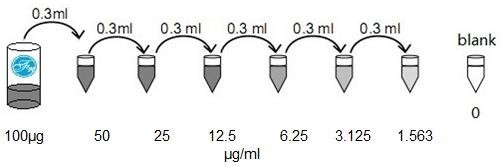
Note: It is best to use Standard Solutions within 2 hours. The Standard Solution shall be at 4°C up to 12 hours. Or store it at -20 °C up to 48 hours. Avoid repeated freeze-thaw cycles.
3, Preparation of Biotin-labeled Antibody Working Solution
Prepare it within 1 hour before experiment.
- Calculate required total volume of the working solution: 0.1 ml / well × quantity of wells. (Allow 0.1-0.2 ml more than the total volume)
- Dilute the Biotin-detection antibody with Antibody Dilution Buffer at 1:100 and mix them thoroughly. (i.e. Add 1μl Biotin-labeled antibody into 99μl Antibody Dilution Buffer.)
Prepare it within 30 minutes before experiment.
- Calculate required total volume of the working solution: 0.1 ml / well × quantity of wells. (Allow 0.1-0.2 ml more than the total volume)
- Dilute the SABC with SABC Dilution Buffer at 1:100 and mix them thoroughly. (i.e. Add 1μl of SABC into 99μl of SABC Dilution Buffer.)
Before adding reagents into wells, equilibrate TMB Substrate for 30 min at 37 °C. When diluting samples and reagents, they must be mixed completely and evenly. It is recommended to plot a standard curve for each test.
- Set standard, test sample and control (zero) wells on the pre-coated plate respectively, and then, record their positions. It is recommended to measure each standard and sample in duplicate. Wash plate 2 times before adding standard, sample and control (zero) wells!
- Aliquot 0.1ml of 100ug/ml, 50ug/ml, 25ug/ml, 12.5ug/ml, 6.25ug/ml, 3.125ug/ml, 1.563ug/ml, standard solutions into the standard wells.
- Add 0.1 ml of Sample/Standard Dilution Buffer into the control (zero) well.
- Add 0.1 ml of properly diluted sample (Bovine serum, plasma, tissue homogenates and other biological fluids) into test sample wells.
- Seal the plate with a cover and incubate at 37 °C for 90 minutes.
- Remove the cover and discard the plate content, and wash plate 2 times with Wash Buffer. Do NOT let the wells dry completely at any time.
- Add 0.1 ml Biotin-labeled antibody working solution into above wells (standard, test sample & zero wells). Add the solution at the bottom of each well without touching the sidewall.
- Seal the plate with a cover and incubate at 37°C for 60 min.
- Remove the cover, and wash plate 3 times with Wash Buffer, and let the wash buffer stay in the wells for 1 minute each time.
- Add 0.1 ml of SABC Working Solution into each well, cover the plate and incubate at 37°C for 30 minutes.
- Remove the cover and wash plate 5 times with Wash Buffer, and let the wash buffer stay in the wells for 1-2 minute each time.
- Add 90μl TMB Substrate into each well, cover the plate and incubate at 37°C in dark within 15-30 minutes. (Note: This incubation time is for reference only, end user shall determine the optimal time.) It will turn blue in the first 3-4 wells (with most concentrated Ig standard solutions), the other wells may not display obvious color.
- Add 50μl Stop Solution into each well and mix them thoroughly. The color changes to yellow immediately.
- Read the O.D. absorbance at 450 nm in Microplate Reader immediately after adding the stop solution.
Note: If the samples measured were diluted, multiply the dilution factor to the concentrations from interpolation to obtain the concentration before dilution.
Summary
- Wash plate 2 times before adding standard, sample and control (zero) wells!
- Add 100μL standard or sample to each well and incubate for 90 minutes at 37°C
- Aspirate and wash plates 2 times
- Add 100μL Biotin-labeled antibody working solution to each well and incubate for 60 minutes at 37°C
- Aspirate and wash plates 3 times
- Add 100μL SABC Working Solution into each well and incubate for 30 minutes at 37°C
- Aspirate and wash plates 5 times
- Add 90μL TMB Substrate. Incubate 15 -30 minutes at 37°C
- Add 50μL Stop Solution. Read at 450nm immediately
- Calculation
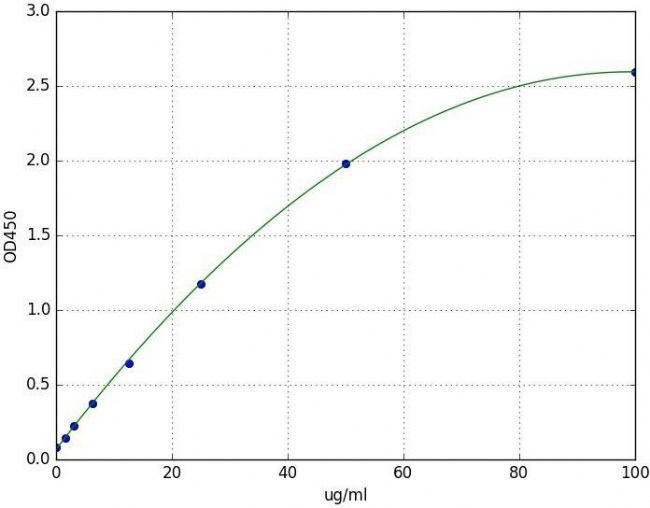
Results of a typical standard operation of a Ig ELISA Kit are listed below. This standard curve was generated at our lab for demonstration purpose only. Users shall obtain standard curve as per experiment by themselves. (N/A=not applicable)
| X | ug/ml | 0 | 1.562 | 3.125 | 6.25 | 12.5 | 25 | 50 | 100 |
| Y | OD450 | 0.079 | 0.145 | 0.227 | 0.378 | 0.643 | 1.177 | 1.984 | 2.592 |
Specificity
This assay has high sensitivity and excellent specificity for detection of Ig . No significant cross- reactivity or interference between Ig and analogues was observed.
Note: Limited by current skills and knowledge, it is difficult for us to complete the cross- reactivity detection between Ig and all the analogues, therefore, cross reaction may still exist.
Recovery
Matrices listed below were spiked with certain level of Ig and the recovery rates were calculated by comparing the measured value to the expected amount of Ig in samples.
Linearity
The linearity of the kit was assayed by testing samples spiked with appropriate concentration of Ig and their serial dilutions. The results were demonstrated by percentage of calculated concentration to the expectation.
Precision
Intra-assay Precision (Precision within an assay): 3 samples with low, middle and high level Ig were tested 20 times on one plate, respectively.
Inter-assay Precision (Precision between assays): 3 samples with low, middle and high level Ig were tested on 3 different plates, 8 replicates in each plate.
CV (%) = SD/meanX100
Intra-Assay: CV<8% Inter-Assay: CV<10%
This assay has high sensitivity and excellent specificity for detection of Ig . No significant cross- reactivity or interference between Ig and analogues was observed.
Note: Limited by current skills and knowledge, it is difficult for us to complete the cross- reactivity detection between Ig and all the analogues, therefore, cross reaction may still exist.
Recovery
Matrices listed below were spiked with certain level of Ig and the recovery rates were calculated by comparing the measured value to the expected amount of Ig in samples.
| Matrix | Recovery Range (%) | Average (%) |
| Serum(n=5) | 86-99 | 92 |
| EDTA Plasma(n=5) | 85-105 | 94 |
| Heparin Plasma(n=5) | 88-102 | 93 |
The linearity of the kit was assayed by testing samples spiked with appropriate concentration of Ig and their serial dilutions. The results were demonstrated by percentage of calculated concentration to the expectation.
| Sample | 1:2 | 1:4 | 1:8 | 1:16 |
| Serum(n=5) | 91-103% | 88-105% | 87-101% | 85-99% |
| EDTA Plasma(n=5) | 82-92% | 85-99% | 86-100% | 83-100% |
| Heparin Plasma(n=5) | 80-92% | 80-96% | 86-97% | 82-97% |
Intra-assay Precision (Precision within an assay): 3 samples with low, middle and high level Ig were tested 20 times on one plate, respectively.
Inter-assay Precision (Precision between assays): 3 samples with low, middle and high level Ig were tested on 3 different plates, 8 replicates in each plate.
CV (%) = SD/meanX100
Intra-Assay: CV<8% Inter-Assay: CV<10%
Stability
The stability of ELISA kit is determined by the loss rate of activity. The loss rate of this kit is less than 10% within the expiration date under appropriate storage condition.
| Standard(n=5) | 37°C for 1 month | 4°C for 6 months |
| Average (%) | 80 | 95-100 |
標簽:
ELISA試劑盒





Copyright(C) 1998-2025 生物器材網 電話:021-64166852;13621656896 E-mail:info@bio-equip.com